Wind Energy Generation in Europe

Which European countries generate most of their electricity from wind power?


For more maps, follow Landgeist on Instagram or X / Twitter or sign up for our newsletter:


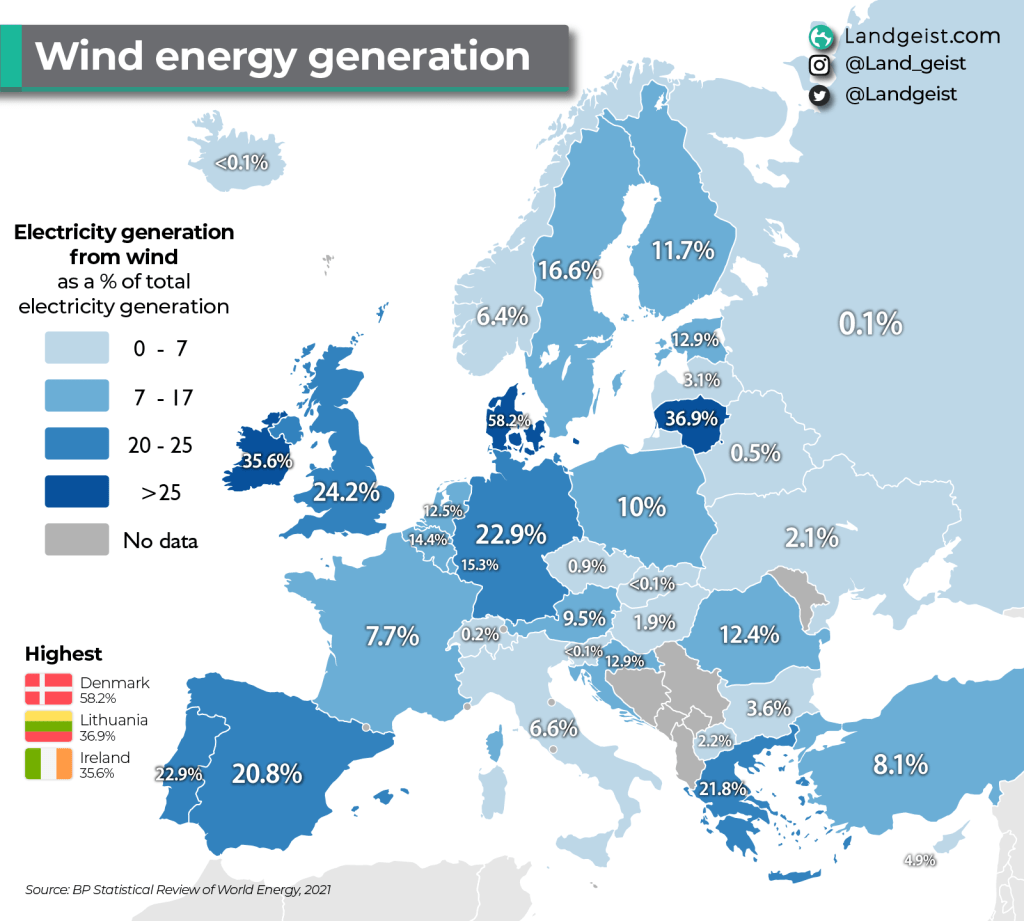
Map of the wind energy generation in Europe.

Like this map and want to support Landgeist? The best way to support Landgeist, is by sharing this map. When you share this map, make sure that you credit Landgeist and link to the source article. If you share it on Instagram, just tag @Land_geist. On X / Twitter tag @Landgeist.

In recent years, EU countries have promised to generate more electricity from greener energy sources. One of them, is wind energy. With a large coastline and windy conditions in many several European countries, it seems to be an ideal continent for wind energy generation.

Wind energy generation is by far the highest in Denmark, where the majority of its electricity generation comes from the wind (58.2%). Lithuania (36.9%) and Ireland (35.6%) also have a much higher electricity generation from wind than other European countries.

Germany is also an interesting country on this map. Compared to countries with a similar percentage, Germany has a much shorter coastline or windy conditions. Germany’s larger number is mostly caused by their large ambition to be greener, but without nuclear energy.

Wind energy generation is a lot lower for most countries that have no or a small coastline. Which is obviously not too surprising.

Data for this map comes from the BP Statistical Review of World Energy. Be aware that the data on this map shows the electricity generation, not consumption. Some countries might produce more electricity than they need and some might not be able to produce enough electricity to meet their consumption and import it from other countries.

6 responses to “Wind Energy Generation in Europe”

  1. Most Used Energy Source in Europe – Landgeist avatar
    Most Used Energy Source in Europe – Landgeist

    […] where the majority of its energy comes from renewables. A lot of its electricity is generated from wind energy. Included in renewable energy is wind, geothermal, solar, biomass and […]

    Like

  2. Ce este mai bine în România decât în țările vestice dezvoltate? – Invictus

    […] În România 12% din producția de energie electrică se obține cu ajutorul turbinelor eoliene (Sursa), procentaj mai mare decât în Franța, Elveția, Austria, Italia, Belgia, Norvegia sau […]

    Like

  3. Ce este mai bine în România decât în țările vestice dezvoltate? – Afirmativ Press avatar
    Ce este mai bine în România decât în țările vestice dezvoltate? – Afirmativ Press

    […] 12% din producția de energie electrică se obține cu ajutorul turbinelor eoliene (Sursa), procentaj mai mare decât în Franța, Elveția, Austria, Italia, Belgia, Norvegia sau […]

    Like

  4. Ce este mai bine în România decât în țările dezvoltate?

    […] România 12% din producția de energie electrică se obține cu ajutorul turbinelor eoliene (Sursa), procentaj mai mare decât în Franța, Elveția, Austria, Italia, Belgia, Norvegia sau […]

    Like

  5. Ce este mai bine în România decât în țările vestice dezvoltate? – Invictus avatar
    Ce este mai bine în România decât în țările vestice dezvoltate? – Invictus

    […] În România 12% din producția de energie electrică se obține cu ajutorul turbinelor eoliene (Sursa), procentaj mai mare decât în Franța, Elveția, Austria, Italia, Belgia, Norvegia sau […]

    Like

  6. Wind Turbines in Europe – Landgeist avatar
    Wind Turbines in Europe – Landgeist

    […] recently looked at how much of Europe’s total energy production comes from wind energy. On this map, we’re going to look where exactly those wind turbines are […]

    Like

Leave a reply to Wind Turbines in Europe – Landgeist Cancel reply