Home Ownership in Europe

What percentage of European households own their home?


For more maps, follow Landgeist on Instagram or X / Twitter or sign up for our newsletter:


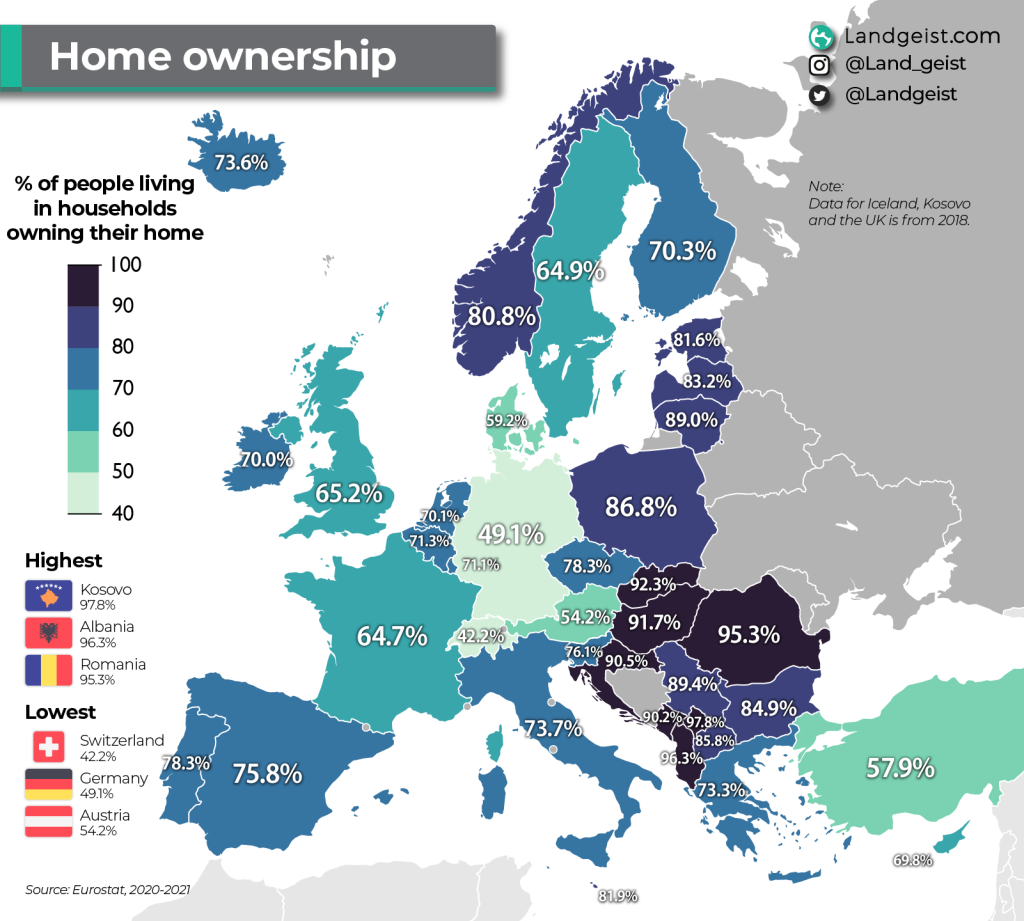
Map of the home ownership in Europe.

Like this map and want to support Landgeist? The best way to support Landgeist, is by sharing this map. When you share this map, make sure that you credit Landgeist and link to the source article. If you share it on Instagram, just tag @Land_geist. On X / Twitter tag @Landgeist.

Home-ownership is an important part of many people’s lives, providing stability, security, and a sense of belonging. In Europe, the rate of home-ownership varies considerably between countries, with some nations having a high proportion of homeowners, while others have a higher proportion of renters.

Home-ownership is more common in Eastern Europe than Western Europe. In countries like Kosovo (97.8%), Albania (96.3%) and Romania (95.3%) it’s even over 95%. Germany (49.1%) and Switzerland (42.2%) have by far the lowest rate of home-ownership in Europe. They are the only countries where home-owners are a minority.

One of the possible factors that affect home-ownership rates in Europe is the availability of affordable housing. In some countries, such as Germany and Switzerland, the cost of housing is relatively high, making it more difficult for many people to purchase a home. Conversely, in other countries, such as Bulgaria and Romania, housing is much more affordable, and home-ownership is therefore more accessible to a greater number of people.

Another factor that could affect home-ownership rates is the prevalence of social housing. In countries where social housing is common, such as the Netherlands and Austria, renters are more likely to be housed in publicly-owned properties, and home-ownership rates are consequently lower.

In conclusion, home-ownership rates in Europe vary significantly between countries and are affected by a variety of factors, including the availability of affordable housing, the prevalence of social housing, and the demographic structure of the population. Despite these variations, owning a home remains an important aspiration for many Europeans, providing a sense of stability and security that can be difficult to replicate through renting.

The data for this map comes from Eurostat.

9 responses to “Home Ownership in Europe”

  1. Buying vs. Renting in Germany: A Financial Guide for Expats

    […] traditions, particularly in countries like Germany where renting is prevalent. As a nation with a low rate of homeownership, Germans may place a high value on owning a home as a symbol of stability, success, and […]

    Like

  2. Hanák Krisztián avatar
    Hanák Krisztián

    You forgot to mention in the summary those who inherited their houses from their grandparents or parents, which is the case here in Hungary. Housing and land are not cheap, and we were just lucky to be in the right place at the right time. I believe it’s not much different in other Eastern European countries, thanks to the construction of Soviet panel apartments and the relocation of peasants/farmers to big cities/towns.

    Like

  3. МНОГУ ГЕРМАНЦИ И ШВАЈЦАРЦИ ЖИВЕАТ ВО ИЗНАЈМЕНИ ЖИВЕАЛИШТА: Зошто во Македонија e поинаку?

    […] што објави веб-страницата „Лангеист“ пред неколку месеци, според податоците земени од […]

    Like

  4. Zoran Uzelac avatar
    Zoran Uzelac

    Kosovo is part of Serbia!

    Like

    1. Arbnor avatar
      Arbnor

      And your mother is a virgin

      Like

  5. Македонците „ПОБОГАТИ“ од Германците и Швајцарците – Живеат во сопствени станови – Вести 365

    […] податоците на „Евростат“ што ги анализира порталот „Лангеист“, 85,9 отсто од жителите на Северна Македонија живеат во […]

    Like

  6. Најголем дел од Македонците живеат во сопствени домови, Германците главно изнајмуваат станови – 360 степени

    […] на домови во Европа објавена на веб-страницата „Лангеист“, според податоци земени од […]

    Like

  7. Proprietari de case în Europa : situația în fiecare țară

    […] fii proprietar este mai simplu pentru că este o mai mare disponibilitate de locuințe, potrivit landgeist.com. Un alt factor care ar putea afecta ratele de proprietate este prevalența locuințelor sociale. […]

    Like

  8. A Crum avatar
    A Crum

    What would be interesting to see is the same map with the percentages adjusted for the proportion of the supposedly “owned” housing stock that is still subject to bank mortgage repayments. If someone has a house but still owes 50% of its value to a bank, they are effectively renting half their property. In the East of Europe this might not change the percentages much, since many homeowners were created by the transfers in their entirety of socialist/communist state-owned properties to their occupants, but in the West of Europe, for example in Spain or the United Kingdom, outstanding property debt could be a significant proportion of the value of housing stock.

    Like

Leave a reply to Proprietari de case în Europa : situația în fiecare țară Cancel reply