
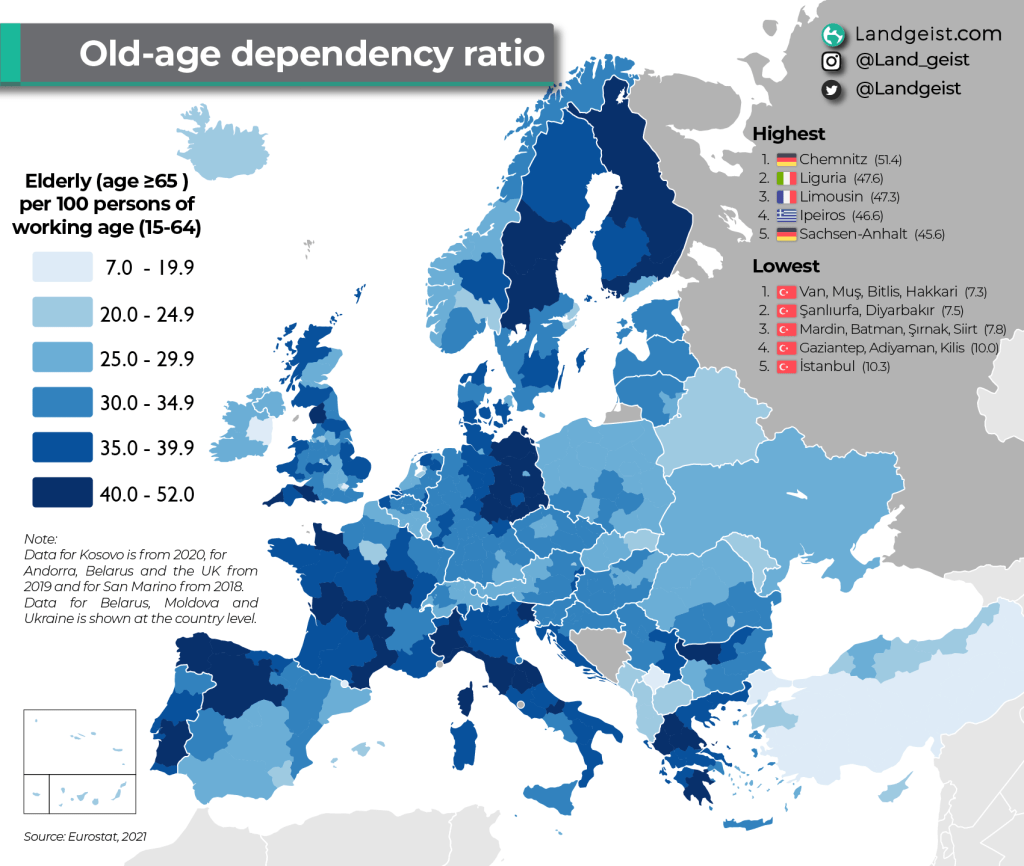
How many elderly people are there for every 100 people of working age in Europe?

Like this map and want to support Landgeist? The best way to support Landgeist, is by sharing this map. When you share this map, make sure that you credit Landgeist and link to the source article. If you share it on Instagram, just tag @Land_geist. On X / Twitter tag @Landgeist.
We’ve already looked at the old-age dependency ratio at the national level. On this map, we’re going to look more closely at the regional old-age dependency ratio.
One of the problems an ageing country faces, is a large population of elderly people that has to be supported by a smaller number of working age people. This is expressed though the old-age dependency ratio. A low old-age dependency ratio means there are plenty of working age people to financially support the pensioners/elderly people. A high old-age dependency ratio means that there is a lot of financial stress on the working age population to support the elderly. A high old-age dependency ratio also creates more stress on the healthcare system, as there is a large demographic that uses the healthcare system and a small demographic that has to work to financially support it.
A high old-age dependency ratio can often be found in wealthy nations with a low birth rate. Especially countries that experienced a baby-boom after the Second World War, now see these baby-boomers retiring.
The regions with the highest old-age dependency ratios can be found in Sweden, Finland, Germany, Spain, Portugal, Italy and Greece. Especially in Germany we can clearly see the border between what used to be East and West Germany. Chemnitz has the highest old-age dependency ratio in all of Europe (51.4).
The lowest old-age dependency ratios can be found in Turkey, Kosovo and Andorra.
Data for this map comes from Eurostat.


Leave a Reply