
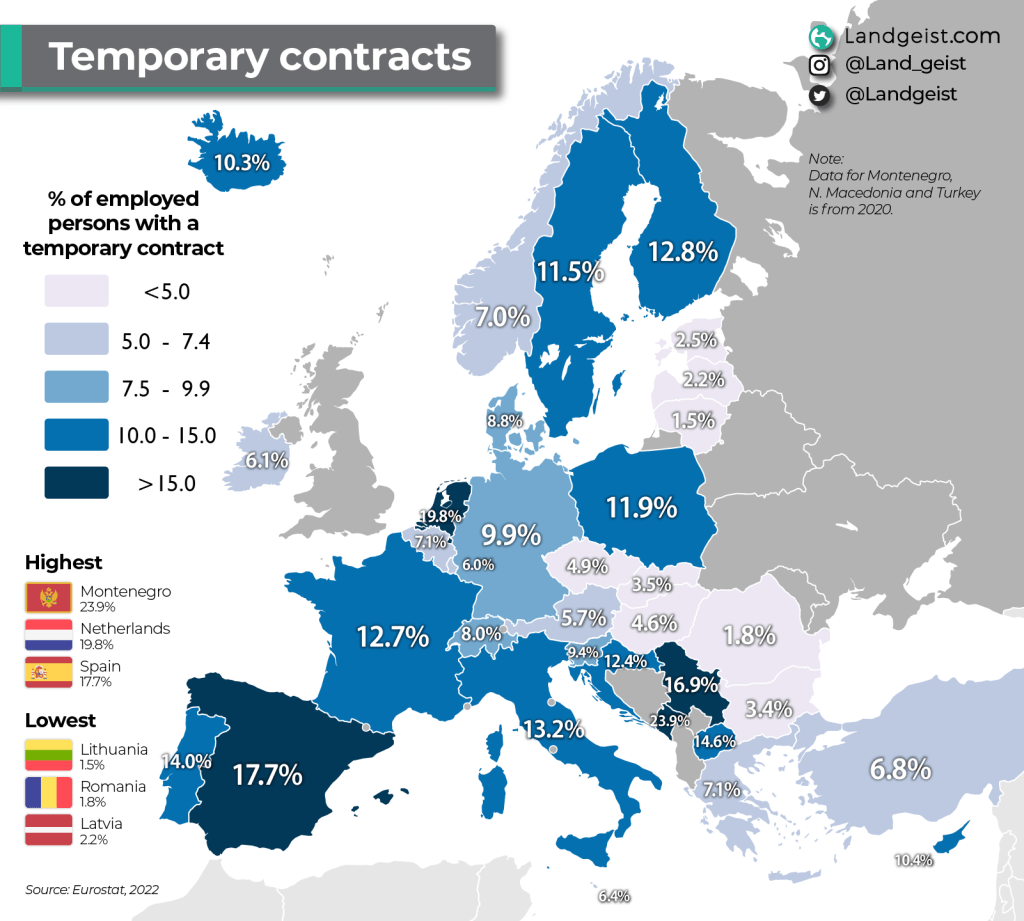
What share of European workers has a temporary contract?
Like this map and want to support Landgeist? The best way to support Landgeist, is by sharing this map. When you share this map, make sure that you credit Landgeist and link to the source article. If you share it on Instagram, just tag @Land_geist. On X / Twitter tag @Landgeist.
The prevalence of temporary employment contracts shows remarkable diversity throughout Europe. Recent data from Eurostat reveals a wide range, with some countries having less than 5% of their workforce on temporary contracts, while others exceed 20%. This variance can be attributed to a combination of factors, including economic conditions, labour market dynamics, and national employment policies.
The reasons behind the popularity of temporary employment contracts also differ across European nations. Some common factors include economic structure, labour market flexibility, and youth employment initiatives. In countries with strong seasonal industries, temporary contracts offer a way to manage fluctuating demands during peak periods. In nations with rigid labour regulations, these contracts provide flexibility to quickly adapt to changing business needs. Additionally, certain countries implement temporary contracts as part of efforts to reduce youth unemployment and provide young individuals with early work experience.
The benefits and concerns associated with temporary employment contracts are also subject to variation. On the positive side, these contracts offer flexibility in work arrangements and opportunities for skill development. Some countries emphasize these advantages, seeing temporary contracts as a means for personal growth and exploration of different career paths. However, countries with a higher prevalence of temporary contracts often grapple with concerns about job security and social inequality. The transient nature of such employment arrangements can lead to financial instability for workers and hinder career progression.
The highest shares of temporary contracts in Europe, can be found in Montenegro (23.9%), the Netherlands (19.8%), Spain (17.7%) and Serbia (16.9%). These are the only countries on this map where the share is over 15%.
The Baltics and Romania have by for the lowest share of temporary contracts: Lithuania (1.5%), Romania (1.8%), Latvia (2.2%) and Estonia (2.5%).
Eurostat defines a employees with a temporary contract as employees whose main job will terminate either after a period fixed in advance, or after a period not known in advance, but nevertheless defined by objective criteria, such as the completion of an assignment or the period of absence of an employee temporarily replaced. The concept of fixed-term contract is only applicable to employees, not to self-employed.


 Landgeist
Leave a comment